
We are digital agency that helps businesses develop immersive and engaging
We are digital agency that helps businesses develop immersive and engaging

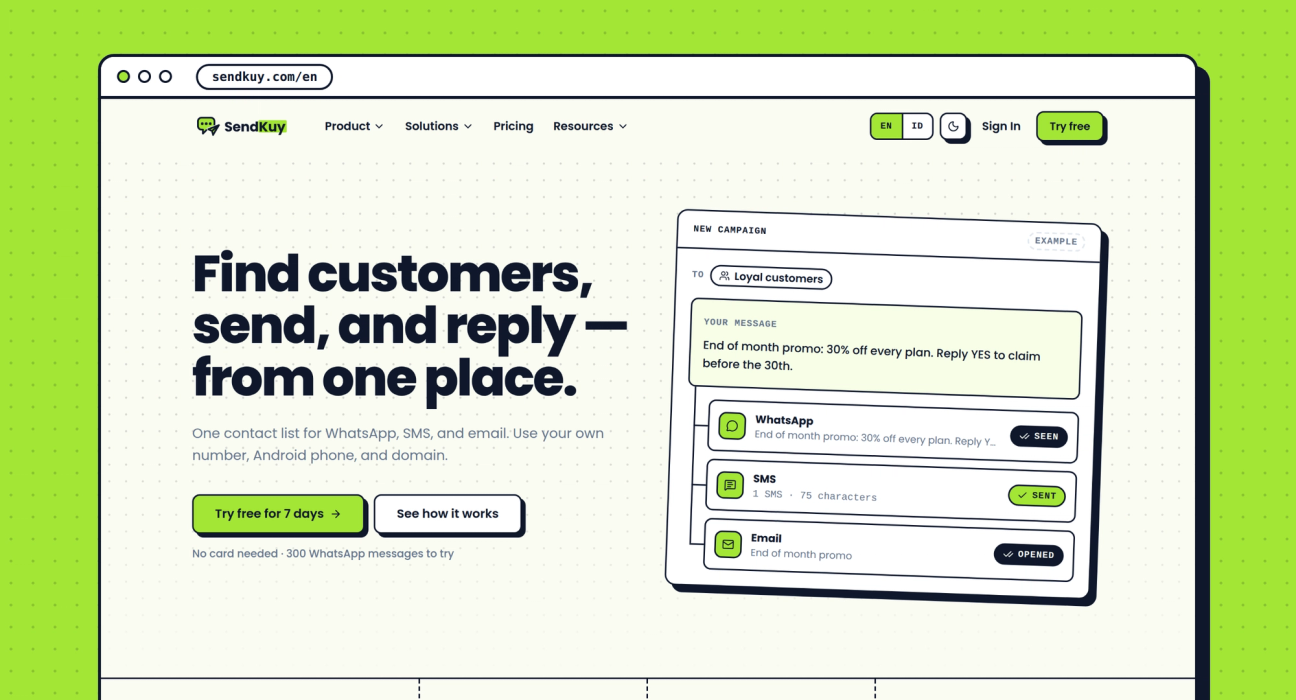
SendKuy is a multi-channel messaging platform for online shops, agencies and startups. A business imports its contacts once, writes a campaign once, and sends it over WhatsApp, SMS, email or all three, with delivery status tracked per channel. Replies from every channel land in one team inbox, and workflows handle follow-ups on their own.
Jago Code designed, built and runs SendKuy as an in-house product. The work covers the web app, a WhatsApp gateway service, an Android companion app that turns a phone into an SMS gateway, a public REST API with official SDKs, and a developer documentation site. The marketing site is bilingual (English and Indonesian) and shows pricing in rupiah and US dollars.
Most small businesses run promos from WhatsApp Business, keep a spare phone for SMS and send email from yet another tool. Their contact lists drift apart, results across channels cannot be compared, and replies get lost across devices. SendKuy had to bring the three channels together without locking every business into one paid provider, and keep sending reliable when a sender goes offline.
We built one contact list and one campaign builder for all three channels. Businesses bring their own senders: WhatsApp through a QR session, the WhatsApp Cloud API or a Chrome extension; SMS through ten providers or their own Android phone; email through SMTP, Amazon SES, SendGrid, Mailgun or Mailjet, with domain verification, bounce handling and a suppression list.
Every send goes through a single sender resolver. When a sender fails, the message moves to the next available one automatically, while messages that may already have been delivered are never sent twice. The Laravel app and the Node.js WhatsApp service exchange events through a retrying outbox with idempotent processing, so no event is lost or applied twice.
The Android companion app pairs a Kotlin background engine with a Flutter interface. It claims messages, sends them from the phone's SIM card and reports each result, and it recovers on its own after a restart.
For teams and developers, SendKuy has roles that keep marketing, support, developers and finance in their own lanes, plus a versioned REST API with scoped keys, signed webhooks and idempotent requests. The OpenAPI contract is enforced by the test suite, and the public pages are server-rendered for search engines.
SendKuy went live in October 2026 at sendkuy.com, with self-serve sign-up, a 7-day free trial and plans from $5 (Rp29,000) a month.
At launch it supports three channels, 19 sending providers, 45 ready-made message templates and 6 workflow templates. Meta approved its WhatsApp Cloud API onboarding, so members can connect their own WhatsApp Business number in a few clicks.
Developers get SDKs for PHP, Laravel and Node.js on Packagist and npm, and a documentation site at docs.sendkuy.com with an interactive request builder and an AI assistant. An automated test suite guards billing, the sending paths, tenant isolation and the public API contract on every change.